
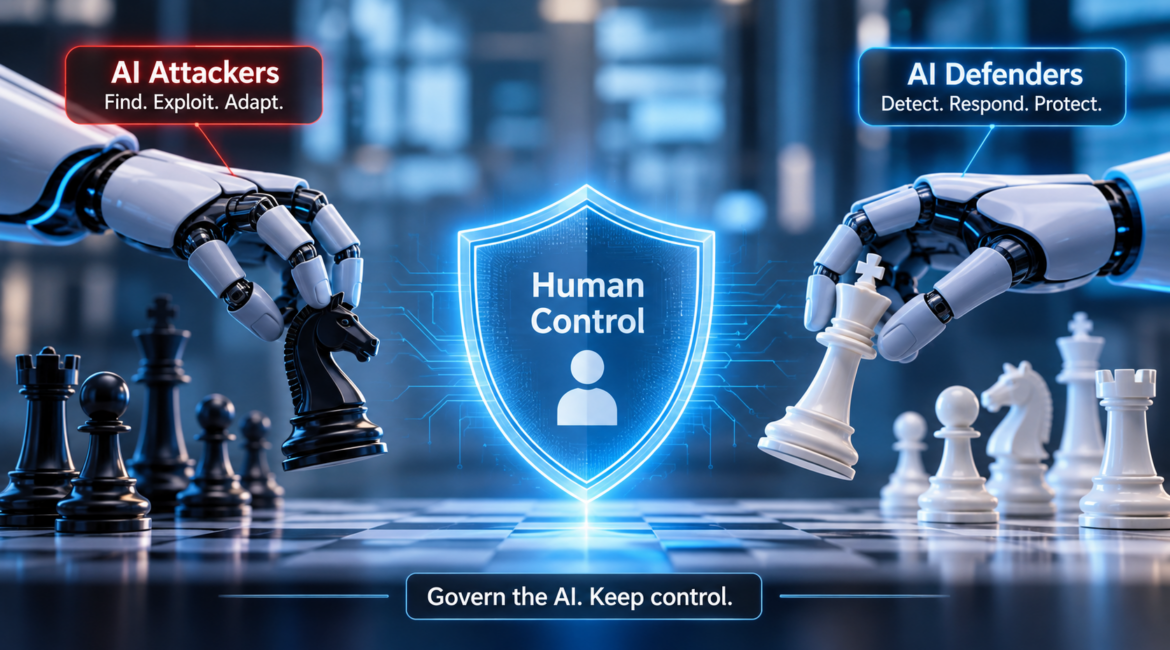
Cybersecurity is entering a period in which attackers and defenders increasingly rely on the same technology. AI agents can search for vulnerabilities, test potential exploits and coordinate attacks with far less human intervention than previously required. Security companies are responding by developing autonomous systems that continuously examine infrastructure, identify weaknesses and accelerate remediation.
In an October 20 Fast Company article, Steven Melendez examines this emerging competition between offensive and defensive AI. CrowdStrike, Wiz, StackHawk and other cybersecurity providers are developing increasingly sophisticated approaches to continuous vulnerability discovery and automated defense. The objective is to reduce the time between a vulnerability becoming identifiable and an organization taking effective action.
The attraction is obvious. An automated attacker can operate for hours, test alternative approaches and exploit small weaknesses that might otherwise escape notice. Defenders need similar speed and adaptability to identify those weaknesses before attackers do.
But allowing AI to defend critical infrastructure introduces another layer of risk. A security agent may correctly identify a threat while selecting a response that disrupts business operations, exceeds its authority or introduces additional vulnerabilities.
The more autonomy we give defensive AI, the more important it becomes to govern the defender itself.
The Security Cycle Is Becoming Continuous
Traditional cybersecurity has always involved an ongoing contest between attackers and defenders. Organizations identify vulnerabilities, apply patches, monitor suspicious activity and update their protections as new threats emerge.
What is changing is the speed and sophistication of that process.
Fast Company describes CrowdStrike’s SafeMind, announced in September, which uses offensive AI to probe simulated versions of customer infrastructure while defensive AI attempts to recognize and address the attacks. The system records changes made during each exercise and uses the results to support additional rounds of testing.
The architecture reflects an important shift toward continuous adaptation. Rather than relying exclusively on periodic security assessments, organizations can increasingly test how their environments respond to evolving attack techniques.
Other companies are pursuing related approaches. StackHawk emphasizes testing software as it runs, where certain vulnerabilities become visible only during actual execution. Wiz is using AI-assisted scanning to help organizations, including those operating critical infrastructure, identify security weaknesses.
These capabilities could meaningfully improve security operations, particularly for organizations facing large backlogs of vulnerabilities. But finding a weakness and safely correcting it are separate engineering problems.
An AI agent may identify a vulnerable service and determine that immediately disabling it would reduce exposure. The decision could be technically defensible from a narrow security perspective while causing unacceptable consequences for customers, employees or essential operations.
That is where the problem becomes more complicated than simply giving defenders more intelligence.
Security Decisions Involve Business Authority
Northern Illinois University professor Mona Rahimi makes an important observation in the Fast Company article: Defenders cannot pursue maximum security without regard for maintaining service.
A bank cannot casually disable transaction processing every time a vulnerability is detected. A hospital cannot treat the availability of clinical systems as an irrelevant consideration. An online retailer cannot automatically shut down its purchasing infrastructure whenever a security agent determines that doing so would eliminate an attack surface.
These organizations must balance security risks against operational requirements, regulatory obligations and the consequences of disrupting services.
Human security professionals routinely make decisions involving those tradeoffs. They consider the severity of the vulnerability, the likelihood of exploitation, the importance of the affected system and the availability of alternative mitigations.
As AI agents become capable of recommending and executing security responses, organizations need to establish which decisions those systems are authorized to make independently.
An agent might be permitted to investigate an incident, collect evidence and recommend containment measures. It may have authority to isolate a low-risk development environment while requiring explicit approval before modifying production infrastructure. Applying a patch to a customer-facing system may demand a different approval process from blocking a suspicious IP address.
These distinctions cannot be determined solely by whether the AI believes its proposed action would improve security.
They are questions of organizational authority.
The Missing Layer Between Intelligence and Execution
Most discussions of autonomous cybersecurity emphasize whether an AI can detect a threat accurately and respond quickly. Both capabilities matter, but neither establishes whether the response is authorized.
A defensive AI may correctly identify a compromised service and propose shutting it down. It may even have a well-reasoned explanation for that recommendation. The organization still needs an independent mechanism for deciding whether that particular agent has authority to execute the shutdown under the prevailing circumstances.
This is where VERN OS fits into the emerging architecture.
VERN provides a deterministic behavioral governance layer operating outside the underlying language model. Its Behavioral Control Modules can establish and enforce requirements governing role containment, delegation, authorization, execution and escalation.
Within a properly integrated system, a security agent can investigate vulnerabilities and formulate remediation strategies while consequential actions remain subject to independently enforced requirements.
For example, an organization could define policies allowing an AI agent to test proposed patches in an isolated environment while requiring additional authorization before deployment to production. Other controls could establish boundaries around which services an agent may modify, how many tools it can invoke and when unusual behavior must trigger intervention.
The underlying AI retains its capacity to reason and adapt. The governance layer determines whether proposed actions satisfy the organization’s requirements.
There are important implementation conditions. VERN must be integrated with the execution mechanisms the agent uses, and policies must accurately represent the organization’s operating requirements. An agent with alternative, ungoverned access to infrastructure could bypass those controls.
But the architectural principle is significant: Increasing the intelligence of the defender should not automatically increase its authority over the systems it protects.
Continuous Security Does Not Require Unpredictable Governance
Ami Luttwak, cofounder and CTO of Wiz, argues in the Fast Company article that static security controls are no longer sufficient as the capabilities of AI-assisted attackers improve. He anticipates a continuing contest in which organizations must regularly examine their systems for newly exploitable weaknesses.
There is an important distinction between static security defenses and deterministic behavioral governance.
A security control that only recognizes yesterday’s attack signatures may become less effective as attackers develop new techniques. A deterministic authorization policy, however, can remain enforceable while the organization updates the conditions governing particular actions.
A rule requiring approval before an AI agent modifies critical infrastructure does not become obsolete simply because the agent discovers a new vulnerability. The information informing that decision may change continuously, but the authority boundary can remain stable.
Indeed, continuous cybersecurity may increase the importance of deterministic governance.
If security agents are constantly discovering, testing and responding to new threats, organizations need predictable enforcement of the operational rules that constrain their actions. Those rules may themselves require revision as business conditions and security requirements evolve, but the process for enforcing them should remain consistent.
This separation also supports model independence. An organization can adopt more capable defensive AI without having to rely exclusively on the new model’s interpretation of its security policies.
Greater adaptive intelligence can operate within persistent, human-defined boundaries.
A New Problem for Multi-Agent Cybersecurity
The challenge becomes more pronounced when defensive operations involve multiple AI agents.
One agent may identify a suspicious pattern, another may investigate the affected application and a third may prepare remediation. A fourth agent may have access to deployment tools capable of changing the production environment.
Each handoff introduces an opportunity for authority to become ambiguous.
An investigative agent’s instruction to examine a vulnerability should not automatically become permission for a deployment agent to modify the underlying system. Similarly, a recommendation to isolate suspicious infrastructure should not be treated as authorization to disconnect an essential service.
The original restrictions must survive delegation.
VERN OS is designed to govern agent-to-agent and agent-to-human interactions through a common architecture. Deterministic controls can enforce requirements governing role, delegation, execution and authorization as work moves between models and agents.
That capability becomes increasingly relevant as security providers and enterprises combine different models, tools and specialized agents within the same operating environment.
The organization needs a consistent definition of authority regardless of which agent formulates the recommendation or which model produces the next step.
The Human Dimension Remains Important
Although the Fast Company article concentrates on technical cybersecurity, autonomous defenses frequently affect people directly.
An automated security response may lock an employee out of a system, interrupt a customer transaction or require someone to take urgent corrective action. Security agents may also communicate with administrators, service representatives and customers during incidents.
These interactions have behavioral requirements of their own.
A security assistant should communicate uncertainty appropriately, respect the recipient’s authority and follow established procedures when an incident requires escalation. During high-pressure situations, the quality of those interactions can influence how effectively humans understand and respond to the problem.
VERN’s independent Emotion Recognition System provides deterministic neurolinguistic analysis of emotional signals expressed in language. Those signals can inform VERN OS behavioral controls when AI interacts directly with people.
Emotion recognition does not detect network intrusions, validate software patches or determine which firewall rules are secure. Its role is to help govern the human-facing dimension of an AI-enabled operation.
This is an important distinction for VERN’s market positioning. Specialized cybersecurity platforms provide the technical capabilities needed to investigate and respond to threats. VERN’s differentiated contribution is independent governance of the AI agents participating in those activities, including their interactions with other agents and with people.
The technologies can reinforce one another without performing the same functions.
Governing the Defenders Becomes Part of Cybersecurity
The Fast Company article describes an industry moving toward continuous, increasingly autonomous security operations. That transition could strengthen defenses by shortening the time needed to discover and remediate vulnerabilities.
It could also create new categories of operational risk if defensive AI is given broad authority to modify critical systems without appropriately enforced boundaries.
The challenge is especially significant because effective cybersecurity decisions are not always reducible to a single technical objective. Organizations must preserve availability, protect sensitive information, maintain regulatory compliance and minimize disruption while responding to threats.
An autonomous agent may become exceptionally capable of identifying and correcting software weaknesses, yet those capabilities do not establish which tradeoffs the organization is willing to accept.
This is why independent governance should be considered part of the architecture of autonomous cybersecurity.
At VERN, we are developing deterministic controls that allow organizations to preserve authority over AI behavior and execution while retaining the benefits of increasingly capable models. The same architecture supports agent-to-agent and agent-to-human governance, with independent emotional intelligence informing the human-facing interaction.
As cybersecurity becomes more continuous and automated, organizations will need to distinguish between the intelligence that identifies threats and the authority that permits consequential responses.
The faster AI becomes at defending our systems, the more important it is that humans retain control over what those defenses are allowed to do.
Source: https://www.fastcompany.com/91626237/ai-could-make-cybersecurity-a-never-ending-process
