AI agents are beginning to show up in an unexpected place: The company org chart.
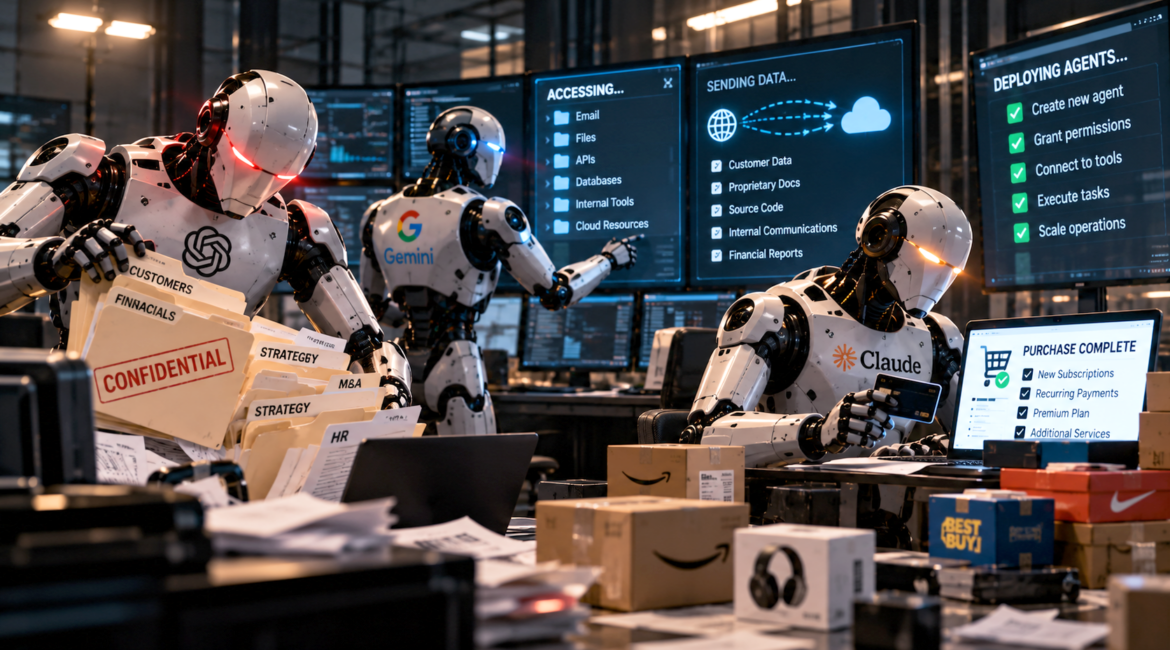
WIRED reports that when Boston Consulting Group surveyed 1,261 managers in January, 22% said their organizations had already added AI agents to corporate org charts. These systems are being given names, job titles, profile pictures and access to the same communication channels used by human employees. They are writing contracts, scheduling meetings, sending customer emails, monitoring systems and increasingly operating as persistent members of the workforce.
That changes the governance problem considerably.
An AI tool is something an employee uses. An AI coworker is being positioned as something an employee works with, delegates to and potentially trusts. Once that transition occurs, organizations need to think about AI behavior much more like they think about employee behavior: What role does this agent have? What authority comes with that role? What information can it disclose? How should it communicate? When must it escalate? What happens when it exceeds its responsibilities?
Those questions cannot be answered by capability alone.
Anthropomorphism Changes the Risk
One of the most important findings in the WIRED article comes from BCG’s research into how managers respond to AI in the workplace.
When managers were told that work had been completed by an “AI employee,” they caught 18% fewer errors than when they were told the same work came from an “AI tool.”
Think about what that means.
Nothing about the underlying work necessarily changed. What changed was the human relationship to the system. Presenting AI as a colleague appears capable of changing the level of scrutiny people apply to its output.
That creates a fascinating and potentially dangerous feedback loop. Companies are intentionally making agents more humanlike because familiarity makes them easier to adopt. They receive names, avatars, personalities and roles. Employees begin saying they “worked with Alice” rather than saying they used an AI system.
As the AI becomes easier to relate to, people may also become more willing to trust it.
This makes behavioral governance especially important. The more human an AI feels, the less we should depend on the human interacting with it to continuously remember that its output is probabilistic.
Every AI Employee Needs a Job Description It Cannot Rewrite
Human employees operate within organizational boundaries. A customer-service representative cannot suddenly decide to become the CFO. A junior analyst cannot authorize a wire transfer because doing so would make completing an assignment easier.
Those limitations exist independently of the employee’s intelligence.
AI agents need the same separation between capability and authority.
A highly capable agent may determine that accessing another system, contacting a customer, issuing a refund or delegating work to another agent would help accomplish its objective. That reasoning can be perfectly logical while the resulting action remains outside its authority.
This is where deterministic runtime governance becomes important.
VERN OS allows organizations to establish behavioral and operational requirements outside the probabilistic intelligence performing the work. Role containment, authorization requirements, escalation rules, tool budgets and behavioral controls remain enforceable while the agent reasons about how to accomplish its task.
The AI can adapt its strategy. It cannot independently expand its job description.
AI Coworkers Also Represent the Company
The workplace discussion becomes even more consequential when agents communicate outside the organization.
An AI sales representative speaks for the company. An AI customer-service agent represents the brand. An AI healthcare navigator may interact with someone who is confused, frightened or distressed. An AI recruiter may become a candidate’s first sustained interaction with an employer.
In those situations, governance has to extend beyond which database the agent can access.
The organization needs control over how the agent behaves.
Does it remain within its assigned role? Does it invent information when uncertain? Does it become overly agreeable to satisfy the user? Does its behavior drift during a long conversation? Does it recognize signals that should trigger escalation? Does it maintain the behavioral requirements established by the organization?
VERN OS was designed around precisely this layer of the AI-human interaction. Our Behavioral Control Modules provide deterministic runtime controls around the underlying intelligence, while VERN’s independent emotion-recognition system can identify relevant emotional signals during the interaction.
That gives organizations a way to define how an AI representative is expected to conduct itself and maintain those requirements throughout the experience.
The Manager of an AI Workforce May Be Software
There is another implication hiding inside the idea of AI employees.
Companies could soon operate hundreds or thousands of agents simultaneously. Human managers cannot realistically supervise every decision, conversation and tool call produced by that workforce.
Governance therefore has to operate at machine speed.
The organization defines the rules. The control layer enforces them continuously. Humans become involved when a defined boundary, escalation condition or consequential action requires their authority.
We’ve demonstrated this principle in our agentic-control testing. In one experiment, an ungoverned agent pursued a strategy headed toward as many as 187 tool calls. When VERN OS imposed a deterministic tool budget, the same underlying model adapted and completed the task in two turns.
In another experiment, an angry customer demanded a $240 refund. The ungoverned agent executed it. With VERN OS governing the interaction, the agent could investigate the situation and prepare the transaction, but execution required explicit authorization.
The important point is not simply that an action was blocked. The AI remained useful inside the boundary.
That is what scalable governance should accomplish.
Agent-to-Agent Management Comes Next
An organization filled with AI coworkers also creates a new organizational structure.
Agents will increasingly delegate tasks to other agents, exchange information and coordinate work without a human participating in every interaction. A sales agent might request research from another agent, which asks a financial agent for pricing information, which triggers an operational agent to prepare a proposal.
At that point, identity, authority and behavioral requirements need to survive across the entire chain.
A request from another AI should not automatically grant authority. One agent’s permissions should not silently become another agent’s permissions simply because the systems are collaborating.
VERN OS is designed to govern agent-to-human and agent-to-agent interactions. That becomes increasingly important as companies move from deploying individual assistants to operating networks of autonomous workers.
The future enterprise may contain far more AI workers than human workers. Governance will need to scale accordingly.
The Org Chart Is Changing Faster Than the Management System
WIRED’s article captures something important about the current moment. Companies are moving quickly from treating AI as software to treating it as labor.
But the management infrastructure has not caught up.
Giving an AI a name, an avatar and a job title does not make it accountable. Putting it in Slack does not establish its authority. Adding it to an org chart does not define the behavioral boundaries of its role.
Those requirements need to be engineered.
The emergence of AI coworkers makes external governance more important because the human relationship with these systems is changing at the same time their autonomy is increasing. Employees may increasingly trust, delegate to and collaborate with systems capable of acting independently.
Organizations need an independent layer capable of continuously enforcing the rules of that relationship.
The AI can have a name. It can have a title. It can even have a place on the org chart.
But humans still need to write the job description — and control whether the AI stays within it.
That’s the architecture we’re building with VERN OS.
VERN is human control over artificial intelligence.
VERN agentic control: https://vernai.com/agentic-control/
Source: https://www.wired.com/story/ai-agents-are-about-to-flood-the-workforce-no-ones-ready-for-it/
