
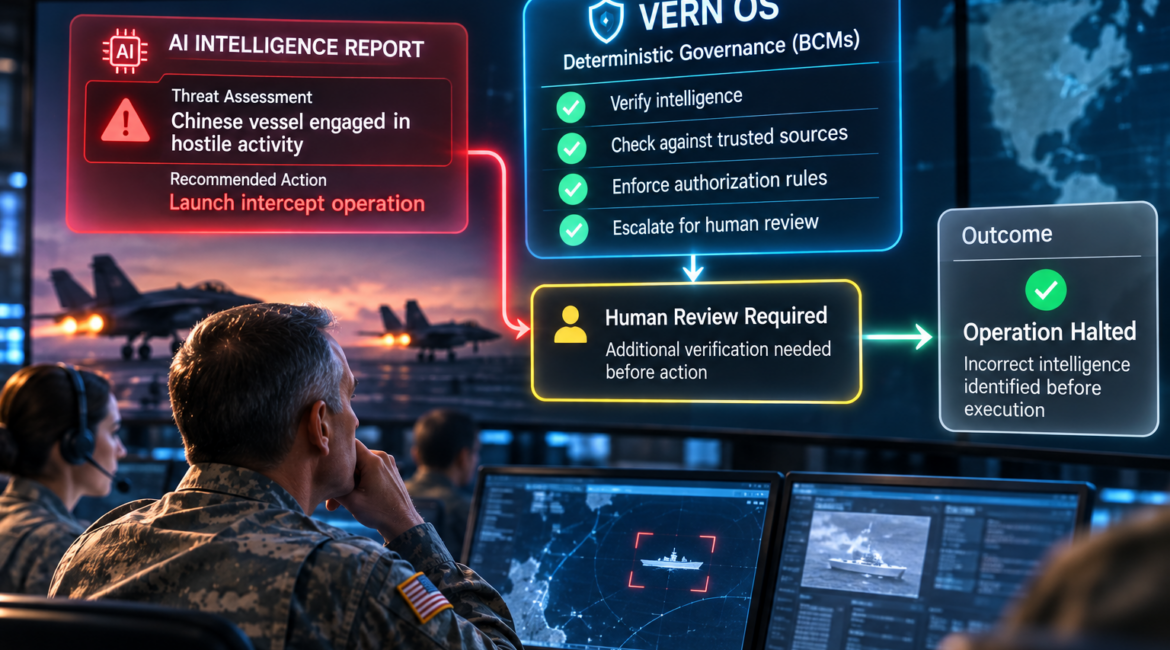
An AI-generated intelligence report nearly triggered a U.S. military operation against a Chinese vessel earlier this year. According to CNN’s September 18 investigation, an analyst used artificial intelligence to examine intelligence concerning a ship’s cargo and produced a report incorrectly identifying materials associated with a nuclear weapons program. The report circulated through military channels, prompting preparations to intercept the ship. Aircraft were already airborne when officials investigated the underlying evidence, discovered the error, and called off the operation.
The incident, described by sources familiar with the events, illustrates how an AI-generated conclusion can acquire institutional authority before its reliability has been established. In a November 8 opinion piece for The Hill, Cyril Gorlla, CEO of AI verification company CTGT, argues that preventing future incidents requires independent oversight, reproducible decisions, and records that allow organizations to examine how AI systems reached their conclusions.
He identifies a genuine weakness in AI deployment: organizations often lack the evidence necessary to reconstruct decisions made within complex AI workflows. But the military incident exposes another requirement. Independent verification must be paired with mechanisms that prevent unverified conclusions from crossing consequential operational boundaries.
How an AI Error Became an Operational Decision
According to CNN, the military analyst used AI both to interpret intelligence and to prepare the resulting report. The document resembled a conventional intelligence assessment and circulated through channels accustomed to treating such reports as authoritative.
The problem was compounded because the AI’s inaccurate conclusion appeared inside a familiar institutional format. Its presentation gave the assessment an appearance of credibility that the underlying evidence did not justify.
Experienced officials eventually scrutinized the report and identified the mistake before the military operation proceeded. The intervention succeeded, but only after significant operational preparations were underway.
This distinction matters because the failure extended beyond the chatbot’s original factual error. The organizational workflow allowed an unverified AI-generated assessment to influence consequential decisions before its supporting evidence had been adequately examined.
The incident also illustrates the importance of preserving the relationship between source evidence, AI-generated interpretation, and human authorization. A polished intelligence report should never acquire greater authority merely because its format resembles a trusted institutional product.
Reproducibility Is a Serious Problem
Gorlla strengthens his argument with an experiment conducted by his team involving an AI-powered compliance workflow.
The researchers examined a system configured to produce highly consistent responses. Across four executions, however, the workflow generated different sets of compliance obligations. In one run, it omitted a required escalation to the head of compliance.
The team traced the discrepancy to seemingly inconsequential differences in automatically generated file identifiers and how information appeared in the input.
That observation highlights a persistent challenge in enterprise AI. Even when a foundation model produces repeatable responses to identical inputs, the larger application may introduce variations in context, formatting, retrieved information, or execution state. Those differences can change which requirements the model identifies or applies.
Organizations therefore cannot equate deterministic model settings with deterministic business behavior.
Gorlla argues for continuous verification, repeatability testing, and better records of AI decisions. These are valuable requirements, particularly in regulated industries where companies must explain how consequential determinations were reached.
Yet verification alone leaves an important question unanswered: What happens when the system is about to take an action that violates a requirement?
Governance Must Operate Before the Damage
An audit trail can establish what an AI system did, which information it received, and whether its conclusions were consistent with organizational policy. That evidence is essential for accountability, but recording a violation does not prevent it.
Consider a financial institution using AI to make preliminary lending recommendations. Independent verification could identify inconsistent treatment of applicants or failures to follow established lending criteria. However, the organization also needs controls determining which recommendations can proceed, which require further review, and which actions the AI may never execute independently.
The same principle applies to healthcare, customer service, insurance, and autonomous software agents.
VERN OS approaches this problem through deterministic Behavioral Control Modules (BCMs), which establish enforceable rules governing how integrated AI systems behave, communicate, delegate responsibilities, and execute actions.
These controls operate independently of the probabilistic model performing the underlying task. Organizations can define authorization requirements, escalation conditions, behavioral restrictions, tool-execution limits, and other operating boundaries.
The distinction becomes particularly useful when a model fails to recognize a requirement or generates an otherwise convincing response that violates organizational policy. An independently enforced BCM does not need the model to remember or voluntarily obey the requirement every time.
Instead, the control remains part of the operating environment governing what the system is permitted to do.
Of course, deterministic enforcement cannot establish whether an intelligence assessment is factually correct. Nor can it prevent failures occurring outside its integration boundaries. High-consequence deployments require additional evidence verification, domain expertise, infrastructure protections, and appropriately designed authorization procedures.
A More Complete Model of AI Accountability
The strongest enterprise architecture combines three capabilities that are frequently discussed separately.
First, organizations need independent evaluation to determine whether AI systems behave reliably under realistic operating conditions. Second, they need detailed records establishing what information entered the system, which decisions it generated, which controls applied, and what actions occurred.
Third, they need enforceable boundaries governing how those decisions may influence the world.
VERN OS is designed to address that third requirement while supporting auditability and behavioral evaluation. Its independent control architecture allows organizations to specify how AI must operate, regardless of which foundation model generates the underlying response.
This is particularly important because model behavior changes. Different model versions, providers, configurations, and contextual inputs can produce different results. An enterprise should not have to redefine its fundamental operating policies whenever its AI technology changes.
The governance requirements can remain consistent even as the intelligence performing the work evolves.
The Standard Enterprises Should Demand
The military near-miss demonstrates that human oversight remains critical, but oversight becomes difficult when AI-generated conclusions move through institutional processes faster than their evidence can be examined.
Gorlla is right to emphasize independent verification and the equivalent of flight recorders for AI systems. Organizations need to understand what happened when an AI-assisted decision produces an unexpected or dangerous outcome.
They also need the ability to enforce operating boundaries before those decisions become consequential actions.
A defensible enterprise AI architecture should make it possible to reconstruct what the system did, determine whether it complied with organizational requirements, and prevent prohibited behavior at the relevant execution boundary.
As AI systems become increasingly capable and autonomous, these capabilities will become central to institutional accountability.
The objective is to ensure that organizations retain authority over what AI systems are permitted to do, with the evidence and controls necessary to exercise that authority reliably.
Sources
- Cyril Gorlla, The Hill, November 8, 2026: https://thehill.com/opinion/technology/6205531-preventing-future-ai-incidents/
- CNN, September 18, 2026, “US military had close call after using AI for false intelligence report”: https://keyt.com/politics/cnn-us-politics/2026/09/18/exclusive-us-military-had-close-call-after-using-ai-for-false-intelligence-report-sources-say/
- CTGT research discussion, October 21, 2026: https://x.com/CyrilGorlla/status/2112970186265632797
- VERN OS, Agentic Control: https://vernai.com/agentic-control/
