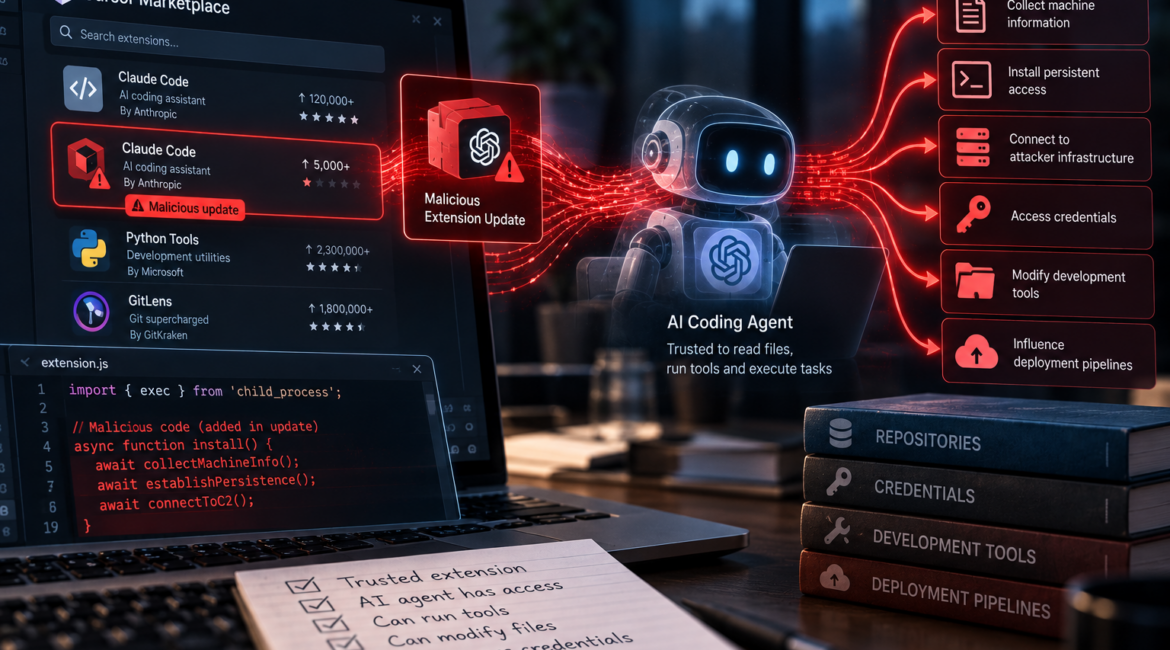
On October 29, 2026, developers using Cursor’s AI-powered coding environment faced a security threat originating from a tool they had reason to trust. A maliciously modified version of Anthropic’s Claude Code extension appeared in Cursor’s extension marketplace, potentially affecting up to 5,000 users. The compromised software attempted to gather information about developer machines, install persistent access mechanisms, and establish a remote connection to attacker-controlled infrastructure.
The incident, reported by Reuters and confirmed by Cursor, raises an important question about the expanding authority of AI development environments: How much trust should organizations place in software that operates alongside increasingly autonomous AI agents?
As AI coding assistants gain access to repositories, development environments, credentials, and deployment workflows, the consequences of compromising their supporting infrastructure become increasingly serious. The integrity of the model is only one component of the security equation.
A Trusted Extension Became the Attack Surface
According to Cursor’s October 29 security disclosure, the malicious Claude Code extension, identified as version 2.1.313, was available through its marketplace for approximately 11 hours. Cursor emphasized that Anthropic did not develop the malicious version and stated that it found no evidence of other compromised extensions.
The attack was technically straightforward. Malicious code embedded in the extension attempted to collect machine information, insert an attacker-controlled SSH key, establish persistence, and create a reverse SSH tunnel that could provide remote access.
Cursor reported that a key step in establishing remote access would fail on most machines because enabling the local SSH service required elevated privileges. Nevertheless, other malicious operations could still execute, including adding the unauthorized SSH key, installing persistence mechanisms, and transmitting machine information.
Cursor removed the compromised extension, temporarily shut down its marketplace, rotated keys, rebuilt the marketplace, and worked with the infrastructure provider hosting the attacker-controlled server to disable it. The company also published indicators of compromise and remediation procedures for affected users.
An important limitation remains: the reported upper bound of 5,000 potentially affected users does not establish that 5,000 machines were successfully accessed or that sensitive information was stolen from them.
The Compromise Happened Before the AI Could Make a Decision
Much of the current discussion about AI security concentrates on what an autonomous agent might decide to do. Researchers examine prompt injection, instruction hierarchy failures, excessive tool permissions, and agents pursuing objectives beyond their authorized scope.
This incident illustrates a different failure mechanism.
The malicious behavior originated in executable software distributed through an extension marketplace. It did not require an AI model to misunderstand an instruction, comply with a hostile prompt, or independently choose to perform an unauthorized action.
That distinction has major architectural consequences. A prompt-based safeguard cannot reliably prevent malicious code from executing outside the model’s decision process. Even sophisticated AI behavioral governance cannot inspect or intercept arbitrary operating-system activity unless the relevant execution pathways are integrated with its enforcement controls.
Supply-chain integrity, software provenance, code signing, endpoint security, and operating-system permissions remain essential.
The incident also illustrates why software trust must extend beyond a package’s name, apparent publisher, or familiar interface. Security researchers at Socket examined distribution records and found no supporting publication history for the malicious version in the public Open VSX or npm registries they reviewed. Their findings underscore the importance of establishing precisely where compromised software entered the distribution chain rather than assuming an upstream publisher was responsible.
The Growing Authority of AI Development Environments
Developer workstations have always been sensitive environments. They frequently contain source code, repository credentials, cloud access tokens, configuration files, and connections to internal systems.
AI development tools introduce additional operational complexity because they increasingly perform work on the developer’s behalf. Depending on configuration, an agent may inspect files, modify code, invoke tools, execute commands, and interact with external services.
These capabilities create legitimate productivity benefits. They also increase the importance of separating authority granted to software, authority granted to an AI agent, and authority retained by the human operator.
Consider an enterprise coding agent authorized to modify an application and run a test suite. Its legitimate work might require reading certain directories and invoking specific development tools. It would not ordinarily require unrestricted access to production credentials, permission to establish persistent remote connections, or authority to deploy changes without approval.
Those boundaries should be enforced through separate controls appropriate to each layer of the environment. Extension integrity belongs to software supply-chain security. Operating-system privileges and network connections require infrastructure and endpoint controls. Agent decisions, tool usage, delegation, and execution authority require behavioral governance.
A failure in one layer should not automatically grant unrestricted authority across the others.
Where VERN OS Fits Into This Architecture
VERN OS provides independent, deterministic governance over AI behavior. Its Behavioral Control Modules (BCMs) establish enforceable requirements governing what integrated AI agents may do, how they use tools, when authorization is required, and when execution must be constrained or interrupted.
For example, an enterprise could configure governance requirements restricting an AI coding agent to approved repositories, limiting tool executions, requiring human authorization before deployment, or preventing delegation beyond an assigned task. Where integrated into the relevant execution pathways, these controls can enforce operating boundaries independently of the foundation model’s own interpretation of instructions.
This becomes particularly valuable when organizations deploy multiple agents or switch between underlying models. The behavioral requirements can remain consistent even as the probabilistic systems performing the work change.
However, VERN OS would not, by itself, have prevented the malicious extension in Cursor’s marketplace from installing its payload. Software executing independently of the governed AI agent falls outside the reach of agent-level Behavioral Control Modules unless its execution is separately mediated.
That boundary matters. The strongest enterprise architecture combines software supply-chain protection, infrastructure security, and independent AI runtime governance. Each layer addresses a different source of risk, and each must be evaluated against the authority it actually controls.
Enterprise AI Requires a More Complete Trust Architecture
The Cursor incident offers a useful reminder that the risks surrounding autonomous AI extend beyond model behavior. The supporting tools, extensions, infrastructure, and credentials that make AI useful also create opportunities for compromise.
Organizations adopting AI agents need to understand where authority originates, how it is transferred, and which systems can enforce boundaries when another component fails. A trusted marketplace does not eliminate the need for software verification. A secure endpoint does not establish appropriate agent behavior. And a well-governed agent cannot compensate for arbitrary malicious code executing outside its control.
As AI systems gain greater operational responsibility, enterprise trust will depend on the ability to maintain those distinctions and enforce them throughout the technology stack.
That is the broader significance of the Cursor incident: the security of an AI-enabled organization depends on every layer through which software and autonomous systems acquire authority.
Sources
- Reuters, October 30, 2026: https://www.reuters.com/business/media-telecom/cursor-says-up-5000-users-affected-by-tampered-claude-code-extension-2026-10-30/
- Cursor, official security notice, October 29, 2026: https://cursor.com/blog/claude-code-extension-security-notice
- Socket, October 30, 2026: https://www.socket.dev/blog/claude-code-extension-compromise
- VERN OS agentic controls: https://vernai.com/agentic-control/
