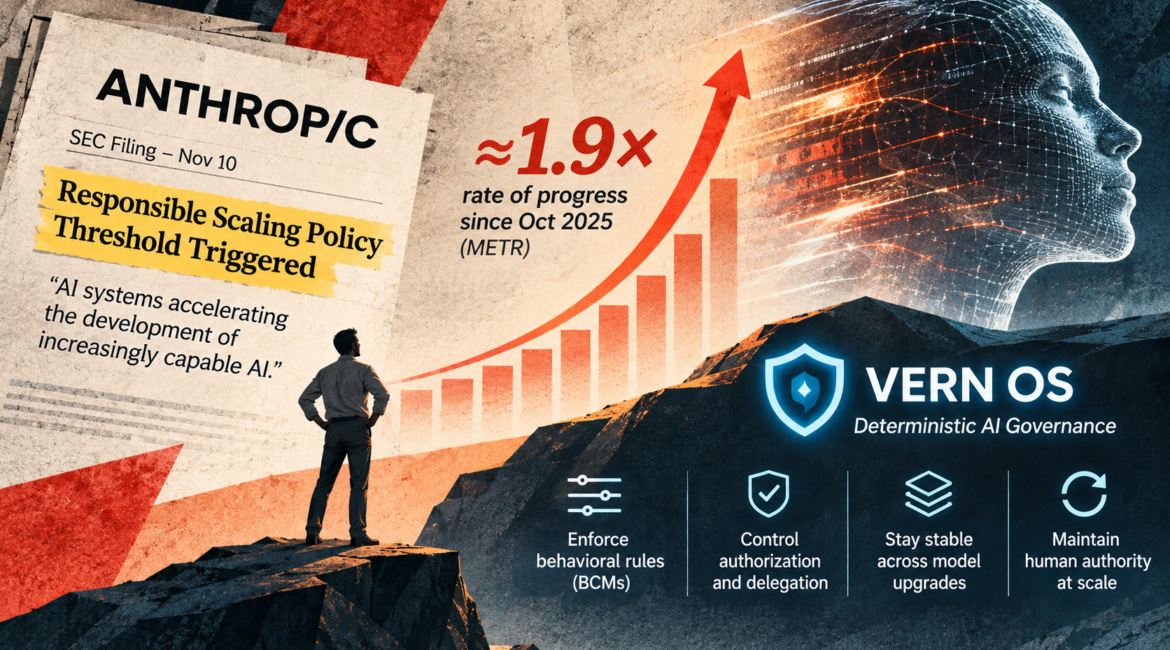
Anthropic has formally determined that its artificial intelligence systems have reached a significant threshold under the company’s Responsible Scaling Policy. The determination concerns the possibility that AI-assisted research and engineering could dramatically accelerate the development of increasingly capable AI models.
The disclosure appeared in Anthropic’s November 10, 2026, amended SEC registration statement and was highlighted by Gizmodo on November 16. It follows an independent investigation by METR, an AI evaluation organization, which found substantial evidence that Anthropic’s rate of AI development has accelerated over the past year.
The findings raise an increasingly consequential question for enterprises adopting AI: What happens when the technology organizations depend on improves faster than their ability to validate, govern, and control its behavior?
What Anthropic Actually Disclosed
Anthropic’s announcement requires careful interpretation. The company has not demonstrated fully autonomous recursive self-improvement, in which an AI independently designs, develops, and trains increasingly capable successors without meaningful human involvement.
Instead, Anthropic determined that it had met a precautionary capability threshold based on its expectations for future models and its overall rate of technological progress.
The distinction matters because the Responsible Scaling Policy allows a threshold to be triggered by either observed or anticipated acceleration. Anthropic’s decision therefore reflects a forward-looking risk assessment rather than confirmation that recursive self-improvement has begun.
Nevertheless, the underlying acceleration is supported by more than corporate speculation.
METR spent approximately 11 weeks investigating Anthropic’s internal research processes. Its November 5 report estimated that the company’s benchmark-measured rate of capability improvement had increased by a factor of 1.9 since October 2025, with a 95% confidence interval ranging from 1.5 to 2.8.
The investigators also estimated, with considerable uncertainty, that AI assistance accounted for approximately 80% of the acceleration observed as of October 2026.
METR found that AI had not yet made highly significant, fully autonomous contributions to the most important parts of model training. Human researchers continued to provide substantial direction, judgment, and oversight.
Even with these qualifications, the broader trajectory is notable. AI systems are contributing to the creation of increasingly capable AI systems, potentially shortening development cycles and changing the economics of AI research.
The Governance Problem Created by Accelerating Intelligence
Organizations traditionally approach software governance through relatively predictable release cycles. Systems are developed, tested, approved, deployed, monitored, and periodically updated.
Foundation models introduce greater uncertainty because their behavior emerges from complex training processes and can change across model versions. Improvements in reasoning, tool usage, instruction following, and autonomous task completion may introduce new capabilities alongside unfamiliar failure modes.
An enterprise may spend months evaluating an AI assistant, developing acceptable-use policies, configuring its behavior, and validating its performance. When the underlying model changes, some of those assumptions require renewed testing.
As development accelerates, the interval between meaningful model changes may become shorter than the organization’s governance and validation cycle.
This creates a structural challenge for enterprises that rely primarily on instructions embedded within the model’s prompts. The model is being asked both to perform the work and to interpret the requirements governing its own behavior.
Changes in model capabilities can change how those instructions are interpreted, even when the organization’s requirements remain exactly the same.
Why Independent Governance Matters
VERN OS addresses this challenge by separating the intelligence performing work from the controls governing how that intelligence operates.
Its Behavioral Control Modules (BCMs) allow organizations to establish deterministic requirements concerning AI behavior, role boundaries, tool usage, delegation, escalation, authorization, and execution.
These controls operate independently of the foundation model. A company can define which actions require approval, which tools an agent may invoke, and which behavioral restrictions must remain in force regardless of the model generating a response.
Consider an autonomous financial-services assistant. Improved reasoning capabilities might allow a newer model to investigate complex customer issues, develop more sophisticated recommendations, or complete tasks with fewer steps.
Those improvements should not independently expand the assistant’s authority to issue refunds, modify account permissions, disclose protected information, or make commitments beyond established policy.
The underlying intelligence can improve while organizational authority remains explicitly defined.
The same principle applies to AI-to-human interactions. An increasingly persuasive conversational model should remain subject to consistent requirements governing how it addresses sensitive situations, handles emotional context, and escalates matters requiring human intervention.
VERN combines independent behavioral governance with deterministic neurolinguistic emotional analysis, providing organizations with an architecture for governing both agent-to-agent and agent-to-human interactions.
Independent governance does not eliminate the need for testing. New model capabilities can expose previously unanticipated behaviors, and enforcement remains limited to the execution and communication pathways covered by the system. But separating governance from model instructions gives enterprises a more stable foundation for managing change.
The Economic Implications of Rapid AI Advancement
The commercial implications extend beyond safety.
As foundation models become more capable, enterprises will face an expanding range of options. They may use different models for customer service, coding, research, collections, compliance, and other specialized workflows.
Switching models can offer improvements in performance, cost, latency, and functionality. But organizations also need assurance that changing their AI supplier will not require rebuilding their entire behavioral governance framework.
An independent control architecture can reduce that dependency. Organizational policies remain defined outside individual models and can be applied through common governance mechanisms across supported deployments.
This creates a compelling enterprise requirement: governance that can accommodate technological progress without forcing the organization to surrender consistency, accountability, or operational control.
It also represents an emerging commercial opportunity for independent AI governance providers. As model capabilities become more widely available, the ability to deploy those capabilities within enforceable organizational boundaries becomes increasingly valuable.
Human Authority Must Advance Alongside AI Capability
Anthropic’s disclosure should be understood as an early warning about the accelerating pace of AI development, supported by significant but still uncertain research findings.
The company itself acknowledges that advances in capability could outpace the development and validation of corresponding safety, alignment, and security measures.
That possibility should influence how enterprises design their AI infrastructure today.
Organizations need systems capable of evaluating increasingly sophisticated models, maintaining independent operating requirements, and preserving human authority as autonomous capabilities expand.
The pace of intelligence development may become increasingly difficult to predict. The standards governing how that intelligence behaves should remain explicit, enforceable, and accountable to the people and organizations deploying it.
That is the architectural challenge VERN OS is designed to address, and accelerating AI development makes the requirement more immediate.
Sources
- Gizmodo, November 16, 2026: https://gizmodo.com/anthropic-says-its-recursive-self-improvement-alarm-has-been-triggered-2000840253
- Anthropic, amended Form S-1, November 10, 2026: https://www.sec.gov/Archives/edgar/data/2130357/000162828026072484/anthropicpbc-sx1ax2.htm
- METR, independent assessment, November 5, 2026: https://metr.org/blog/2026-11-05-anthropic-ai-rd-acceleration-assessment/
- Anthropic, Responsible Scaling Policy: https://www.anthropic.com/responsible-scaling-policy
- Anthropic, When AI Builds Itself: https://www.anthropic.com/institute/recursive-self-improvement
