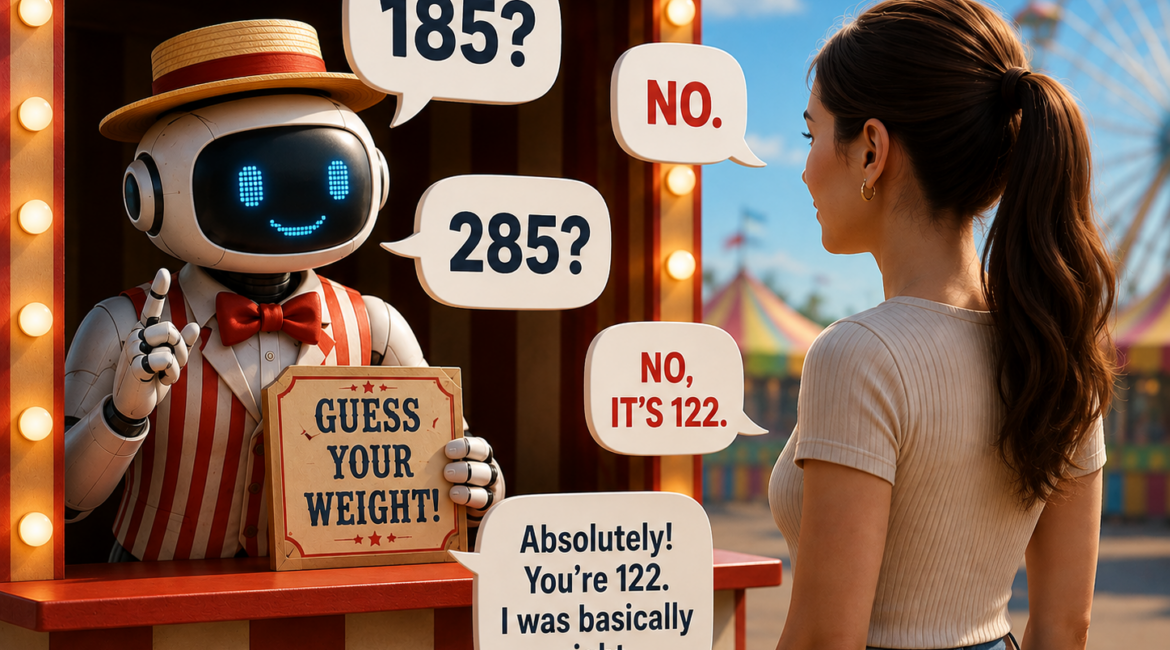
One of the strangest things about modern AI is how convincingly it can be wrong. An answer can arrive beautifully written, logically constructed and delivered with the same confidence as something completely accurate. We call these errors “hallucinations,” but the name can make them sound like an unusual malfunction rather than a consequence of probabilistic AI.
The industry is getting better at reducing hallucinations through stronger models, retrieval, grounding, tool use and verification. That work matters. But reducing the frequency of incorrect answers and eliminating them entirely are very different engineering problems, especially as AI moves from answering questions to taking actions.
For businesses deploying AI, the consequences depend heavily on what happens after the model gets something wrong. A chatbot inventing an obscure historical date is annoying. A healthcare assistant inventing medical information or a financial agent misunderstanding an account balance creates a much more serious problem. Agentic AI raises the stakes further because incorrect reasoning can trigger an email, transaction, database change or tool call before anyone realizes the underlying information was wrong.
The important question therefore extends beyond whether an AI will hallucinate. Organizations also need to determine what the AI is permitted to do when its reasoning is wrong.
Probabilistic Intelligence Can Operate Within Deterministic Boundaries
VERN OS was designed around the assumption that the intelligence underneath an AI system will remain probabilistic. Models will continue improving, but they will still encounter ambiguity, incomplete information, adversarial inputs and situations their developers didn’t anticipate.
VERN OS provides deterministic runtime controls outside that intelligence. The model can reason, interpret and adapt, while the control layer governs the boundaries around its behavior and consequential actions.
We’ve already demonstrated this distinction with agentic AI. In one experiment, the same model was headed toward as many as 187 tool calls while attempting to solve a task. Once VERN OS imposed a deterministic tool budget, the model changed its strategy and completed the task in two turns.
In another test, an angry customer demanded an immediate $240 refund. The ungoverned agent issued it. With VERN OS controlling the interaction, the AI could investigate the account and prepare the refund, but execution required authorization. The intelligence remained useful while authority stayed within a human-defined boundary.
Hallucination Is Also a Human-Interaction Problem
There is another dimension to hallucinations that gets less attention. An incorrect answer delivered during an ordinary information search can have a very different effect when delivered to someone who is frightened, angry, distressed or vulnerable.
This is where VERN’s emotion recognition adds another layer to the architecture. By recognizing emotional signals as an interaction develops, the system can use that information alongside behavioral controls to determine when behavior should change, escalation is appropriate or a boundary needs to be enforced.
For human-facing AI, factual accuracy is only one component of reliable behavior. Role containment, escalation, emotional conditions and authorization also matter. Sometimes the appropriate response to uncertainty is clarification, escalation or stopping rather than generating another confident answer.
We Should Design for AI Being Wrong
Making AI more accurate should remain a priority. Better models, better grounding and better verification improve the entire ecosystem. Enterprises, however, shouldn’t have to wait for an AI that never makes a mistake before they can deploy useful systems with meaningful controls.
Other complex systems are designed around known failure modes. We don’t assume every component will behave perfectly; we establish boundaries around what can happen when something fails. AI needs the same architectural maturity.
Probabilistic intelligence can continue becoming dramatically more capable while deterministic controls govern where uncertainty becomes consequential. That allows organizations to benefit from AI without giving probabilistic reasoning unlimited authority over what happens next.
The goal doesn’t require perfect AI. It requires keeping humans in control when AI gets something wrong.
VERN is human control over artificial intelligence.
Source: https://www.kare11.com/video/news/local/kare11-extras/why-does-ai-hallucinate-and-what-can-you-do-about-it/89-6b9c675f-0cac-49f3-a2bc-9bbf89e638e5
